Legendary's Godzilla 2014 News, Updates, And More IDW's Godzilla: Rulers Of Earth And Other Kaiju Comic News, Previews, And More Pacific Rim News, Updates, And More X-Plus, S.H. MonsterArts, And More Kauji Toy News, Previews, And More Kaiju Battle's Creature Feature: Learn All About The Many Kaijus
Showing posts with label Godzilla. Show all posts

Wednesday, March 12, 2014

Book Featuring All Of Toho's Monsters Coming In July

Shogakukan / Books

Toho Special Effects All Monster Picture Book

written by: Toho tentative price: 4,000 yen + tax body (planned) 208 page A4 size luxury binding variant will be released July 23 of 1954 from "Godzilla" latest "GODZILLA up ", and complete recording about 900 animals all Toho monster that has produced special effects in film and television works! Gorgeous! "Picture book for adults" dedicated to the fan who loves the monster may not be subject to change * Cover Design

Translated with Google

Godzilla Is Timeless!

From Voice Without A Face

With the new Godzilla just about 2 months away, comes new fans with an interest in the monster, and hopefully the genre in general. So let’s take a look at how my favorite fictional character has survived and made his mark in our minds, our hearts, and our building structures.  

Making his debut in the 1954 classic simply titled Godzilla. (Gojira in Japan.)   What made  this movie such a hit at it’s time? More then stellar effects. ( I see you uneducated people giving me looks.)   What made it popular is that it hit home with a lot of Japanese just 10 years after the atomic bombs were dropped on two of their cities.   For those who don’t know what the original Godzilla is really about, there’s tons of things you can read, for that, but to put it simply, he was a metaphor for the atomic bomb, the film itself and anti nuke and and anti war film. Creating scenes frightening  similar to those from the real traumatic event, from the country that experienced it first hand.    The rushed sequel, Godzilla Raids Again or Godzilla’s Counter Attack,  can fit into the 50’s b monster genre, however some themes still remain, talk of shelters and a chilling scene  reminiscent  of American fire raids, but for the most part fit into the drive in movie scene, which is exactly where it found itself in the states, re-titled to Gigantis the Fire Monster!(Where do they get this stuff?)

For almost a decade Godzilla would not be scene again, Toho experimenting with other monsters  and genre’s. When the time came to bring Godzilla back to the theater, in color none the less! It was with the unconquerable King Kong!  Both monsters now leaping onto the color screen for a battle of the century.   Now again we find a butchered american version, however the Japanese version Is a clever satire film ,  poking fun at the mass commercialism at the time. This combine with the monster performing wrestling moves, all the rage in Japan back then, choreographed by stuntmen and suit actors Haruo Nakijima(Godzilla) and Shoichi Hirose (KingKong). These elements ended up making King Kong vs Godzilla the highest grossing film of the franchise.    Clearly monster battles where the way to go, next pitting Godzilla against another famous monster from one of Toho’s previous films, Mothra!   This time Godzilla was a little less silly. (Albeit I think he was drunk with all the stumbling.)  However the darker Godzilla proved to carry the film, bringing with it not only a spectacular duel with the insect deity, but a very well put message about greed, corruption and being at peace with your fellow man. While not as big a hit as King Kong vs Godzilla money wise, Mothra vs Godzilla (Godzilla vs The Thing) remains number 1 on a lot of peoples lists, a true display of the golden age of Japanese science fiction at the top of it’s game.


Sunday, March 2, 2014

Godzilla Snickers Commercial Actor - Douglas Tait: The Monster Man

Douglas Tait is the guy in the Godzilla suit in the Godzilla Snickers commercial check out his personal page here and his other page The Monster Man here.


Godzilla German Blu-ray Releases Coming From Splendid


Amazon's German page has listings for Godzilla films to be released on Blu-ray from Splendid Film they include Godzilla (1954), Godzilla Raids Again, Godzilla Tokyo SOS, GMK All Monster Attack, Godzilla 2000 Millennium, Godzilla Final Wars, Godzilla vs. Destoroyah, Godzilla vs. Mechagodzilla 2, Godzilla vs. Spacegodzilla. They are being released in March and April and are listed at EUR 11.99 (approx $16.50).


The Reality Of Godzilla: Lucky Dragon 5 And The Terrifying Truth That Inspired Godzilla


From Badass Digest, originally published in the "Beasts vs. Bots" issue of Birth.Movies.Death. 

The story of the Japanese tuna fishing boat contaminated by nuclear fallout from Castle Bravo.

A small Japanese fishing boat floats quietly at sea. The fishermen are making music, playing games and sleeping on deck. Suddenly, their tranquil moment is shattered by the sound of an explosion. The fishermen all rush to the railings, looking out across turbulent waters. Piercing white blindness overtakes everything, and their screams are silenced by an unseen, all- consuming force.

That’s the opening scene of Ishiro Honda’s Godzilla, but to Japanese audiences of the time, it was an instantly recognizable tribute to a very recent tragedy. On March 1, 1954, the crew members of the Daigo Fukuryu Maru (or Lucky Dragon 5), a 140-ton fishing boat out of Yaizu, Shizuoka Prefecture, were exposed to fallout from the test explosion of a U.S. hydrogen bomb detonated at Bikini Atoll. The Lucky Dragon tragedy galvanized an emerging movement against nuclear weapons in Japan, spearheaded primarily by housewives in Tokyo’s Suginami Ward; the ill-fated boat emerged as an enduring symbol of protest against the proliferation of weapons capable of eradicating all life from the surface of the planet.

Under the command of an inexperienced 22-year-old captain named Hisakichi Tsutsui, the Lucky Dragon left port on Jan. 22, 1954 with an underpowered engine capable only of 5 knots, and was beset by mechanical malfunction almost immediately. Less than three weeks into its voyage, as it was rounding the southern tip of Midway Island, nearly half of the ship’s 330 fishing lines were caught on coral reefs and lost. Unwilling to return home in failure, Tsutsui chose instead to head south to the Marshall Islands, in hope of finding a plentiful haul of bigeye tuna. No member of the crew was aware that the Japanese Maritime Safety Agency had been alerted by the U.S. government of planned nuclear tests, and that an exclusion zone had been established around Bikini Atoll extending eastward to longitude 166 16.

By the end of February, the Lucky Dragon’s supplies were exhausted and fuel was nearly depleted. Noting their longitude at 166 18 (still safely, though obliviously, outside the exclusion zone), the crew planned for one final day of fishing on March 1 before returning home to port. At 6:45 am on “the Day the Sun Rose in the West,” a blast of light cut through the morning darkness. Crewman Matakichi Oishi described seeing the detonation: “A yellow flash poured through the porthole. Wondering what had happened, I jumped up from the bunk near the door, ran out on deck and was astonished. Bridge, sky and sea burst into view, painted in flaming sunset colors.”

He was witnessing Castle Bravo, the first ever test of a dry-fuel thermonuclear device. And, oh man, did it go completely wrong. The bomb’s engineers at the Los Alamos Laboratory miscalculated, and instead of the bomb blast delivering a planned yield of 6 megatons, it yielded an unimaginable FIFTEEN megatons! It was the biggest explosion ever caused by human beings, and over 1,000 times more powerful than the bombs dropped on Hiroshima and Nagasaki.

The Lucky Dragon 5 survived the initial blast, but soon, a mysterious cloud of white “death ash” began to softly rain down on the ship. Later tests determined it was atomized coral, the ghostly remains of the habitat they were there to fish. Oishi recalled:“The top of the cloud spread over us…. Two hours passed…. White particles were falling on us, just like sleet. The white particles penetrated mercilessly – eyes, nose, ears, mouth. We had no sense that it was dangerous.” For six hours after, they patiently hauled in their fishing lines before weighing anchor.

That evening, the crew members began to feel nauseous, exhibiting early symptoms of radiation poisoning. By the time they reached Yaizu on March 14, they were covered in burns, bleeding from their gums and barely able to open their eyes. The 23 crew members were quarantined outside the city, and all their clothing and belongings were buried. Meanwhile, the fish they brought back with them were somehow accidentally unloaded and taken to markets across Tokyo. The government soon began a frantic search to recover the entirety of the catch, but by the time it was concluded, at least two full tuna had been sold and likely consumed.

In the aftermath of the Castle Bravo test, the Ministry of Health and Welfare concluded that 856 Japanese vessels were exposed to radiation from the detonation. The Japanese fishing industry was crippled. Prices plunged, and between March and December of 1954 alone, over 75 tons of tuna were destroyed after being found unsafe to consume. And America’s response? The Atomic Energy Commission accused the Lucky Dragon of being a spy vessel, sent to discover military secrets. They denied any negative effects from the test, claiming “there [was] negligible hazard, if any, in the consumption of fish caught in the Pacific Ocean outside the immediate test area subsequent to tests.” At the very same time however, America instituted much tighter regulations on all imported fish.

The Lucky Dragon’s chief radio operator, Aikichi Kuboyama, died in September of 1954 at age 40, the first Japanese victim of a hydrogen bomb. The US government eventually gave a meager two million dollars to the Japanese government as compensation for unspecific damages resulting from the Castle Bravo test. A diplomatically positioned ex-gratia statement made it clear that America was assuming no responsibility and that the payment was merely intended as a sympathetic gesture. The whole incident caused a tremendous amount of unrest in Japan. A large number of outraged Japanese citizens identified closely with the crew of the Lucky Dragon 5, and over 400,000 people attended Kuboyama’s funeral. Following this incident, the anti-nuclear movement quickly became a powerful voice in Japan. And then in November, Godzilla was released.

Beyond the opening scenes, which encapsulate the tragedy of the Lucky Dragon 5, director Ishiro Honda’s film grapples with the consequences of nuclear weapons with more direct intentionality, gravity and integrity than any film we would see for the next thirty years. Having been drafted into the Imperial Japanese Army, Honda spent the last six months of the war as a prisoner in China. In 1946 he was repatriated through Hiroshima, witnessing firsthand the aftermath of the nuclear attack. Those traumatic sights left a lasting impression which would be filtered throughout his entire body of work. He deliberately staged Godzilla’s destruction of Tokyo as a slow-motion, personified version of a rolling nuclear attack like those perpetrated against Japan.

Watching Godzilla today, the weighty moral quagmires that form the backbone of the narrative still feel urgent and unresolved. The film continues to resonate in part simply due to the masterful artistry and applied craft of Honda, special effects genius Eiji Tsuburaya and composer Akira Ifukube. The insane originality of their vision still pops with a vibrancy lacking from contemporary CGI-ridden blockbuster still-births. But I think primarily the film still stands out - even from its 27 increasingly fun and outlandish sequels - because it struggles so earnestly with large-scale questions of guilt and responsibility.

In Godzilla, a film that boldly accepts our reality as one in which human beings can willfully tear apart and destroy the fundamental particles of the universe, a scientist character played by Akihiko Hirata has created an Oxygen Destroyer that can disintegrate oxygen atoms. After Godzilla is awoken from his underwater sleep by a nuclear detonation, it becomes clear that the Oxygen Destroyer is likely the only weapon that can get rid of him. The scientist agonizes over the decision to use his new invention, terrified by the possibility that, once introduced to the world, such a weapon could never truly be contained. Ultimately, he resolves to use it, but not before burning the records of his life’s work to prevent others from abusing such destructive knowledge. After Godzilla’s defeat, he sacrifices himself, ensuring that the secrets of the Oxygen Destroyer would die with him.

In later Godzilla movies, humans  are often forced to manipulate one giant monster into helping defeat another, more immediately dangerous one. But in the end, they’re still always stuck with a giant goddamn monster to deal with. The abundance of crazy creatures in the Godzilla franchise reflects the paranoid politics of mutually assured destruction during the Cold War. Godzilla himself represents the potential for the complete destruction of everything, and the unfathomable consequences of fucking around with forces powerful enough to destroy all life on Earth.

The movie still resonates because that omnipresent threat of annihilation hasn’t gone away. After the disaster at the Fukushima Daiichi nuclear power plant in 2011, the Lucky Dragon 5 embarked on a symbolic new voyage, acting as a vivid reminder of the almost incomprehensible dangers of “peaceful” nuclear technology. If that threat of total extinction doesn’t ring with the same urgency that it did during the Cold War, it’s partly because we’ve just become accustomed to it, grown up with it as a simple fact of modern life. Over time, we've come to accept the idea that we’re irreparably ruining this planet, an idea that decades ago had already found expression in 27 incredible movies starring a guy in a rubber monster suit.

Humans won’t be here forever. Maybe we don't really belong here at all anymore. Maybe ours is a world intended for giant monsters instead.

Thursday, February 27, 2014

BBC Documentary On Godzilla

This was put on YouTube last year but still cool, well except for the opening "effects".

Wednesday, February 26, 2014

The Reality Of Godzilla: Declassified Video Of The Bombing To Kill Godzilla


Here is a video declassified talking about the Operation: Castle nuclear tests which happened in 1954 to destroy Godzilla. Watch and learn the truth. (Courtesy of Everything Kaiju)

Sunday, February 9, 2014

Interview Of The Godzilla Encyclopedia Publisher Kouhei Nomura

From Japan Times

Kouhei Nomura published a glossary titled “The Godzilla Encyclopedia” in 2004 after six months of dedicated research. He delivers his verdict on why the king of the monsters is so popular worldwide.
Do you have a favorite “Godzilla” movie?

The original “Godzilla” that was released in 1954 remains in a class of its own. There is something in the air throughout the film I can’t put my finger on, and there is also a strong anti-nuclear message. I’ve seen it dozens of times but I’ve never grown tired of it. However, it’s important to note that the version that was released in the United States was heavily edited. The U.S. version (titled “Godzilla, King of the Monsters!”) includes new footage featuring actor Raymond Burr, who plays an American journalist in Japan. The plot is basically the same, but the path Godzilla takes is a bit absurd, because he goes from Ginza to the National Diet, and then back to Ginza and so on.

What was the first “Godzilla” movie you saw?

“King Kong vs. Godzilla,” which was released by Toho Studios in 1962. That was also the first movie I ever saw in a theater. It was both scary and powerful at the same time. And there was also a hint of comedy in the story line, which I enjoyed. While the original “Godzilla” was great, I also like watching the films in which Godzilla battles a rival monster.

Godzilla has a star on the Hollywood Walk of Fame. In your opinion, why does the monster have universal appeal?

Personally I think it’s a combination of the film’s human drama and the powerful images. I think fans overseas were impressed by the special effects, which at the time were groundbreaking. Years later, Godzilla became closely linked with Japan and, ultimately, was considered to be a symbol of the country’s pop culture.

A reboot of “Godzilla” is coming out in the U.S. this year. What is your take on Hollywood remakes of “Godzilla?”

“Godzilla” movies made in the United States are not “Godzilla” movies, they are just movies about a gargantuan living creature. The very idea of Godzilla is different. In the United States, Godzilla is something that can be overcome with military weapons, but that isn’t necessarily the case in Japanese versions. Over here, Godzilla is more than just a giant creature. It’s in some way a metaphor for natural disaster. It can’t simply be beaten. Godzilla is more than a monster, it’s a symbol. However, don’t get me wrong. I will definitely see the new “Godzilla” movie in theaters, in the same way that I watched the Roland Emmerich version (in 1998).

Godzilla is a sexagenarian. What do you think will happen to him next?

After “Godzilla: Final Wars” (2004), Toho Studios announced they had decided to pull the plug on the series, presumably because of the increasing costs. However, the popular “Always Zoku Sanchome no Yuhi” (“Always: Sunset on Third Street 2″) film that was released in 2007 opened with footage of Godzilla destroying Tokyo [one of the characters in the movie was imagining this]. It shows there is still demand for Godzilla in Japan. Circumstances might not be right to film a sequel now, but I am hoping Toho surprises us and puts out a new movie. That would be awesome.

Note: about the book,
In this photobook, Kodansha has published hundreds of bright color and black/white tokusatsu pictures many of which have not appeared in the other Godzillla books published previously.  Such a fresh look is one reason that distinguishes this book from so many other ones, that and the fact that this is the most current book published that sequentially chronicles the entire history of not only Godzilla but also almost all of the rest of the Toho SFX catalog from 1954 to 2004.

In addition to all 28 of the Godzilla movies to date, the book also includes the other films, mostly from the triumvirate production team of Tananka, Honda and Tsuburaya:  such Toho classics as Rodan, the Mysterians, Battle in Outer Space, Varan, Mothra, Ghidrah, Frankenstein Conquers the World, H-Man, Human Vapor, Matango, Atragon, Yog, King Kong Escapes, the 90's Mothra trilogy and many, many more.

Everything You Ever Wanted To Know About Godzilla But Were Afraid To Ask

From The Japan Times

The sound effects team initially tried to create Godzilla’s distinctive shriek by using animal roars that had been tweaked through editing. They sampled all kinds of birds and mammals, but nothing seemed to be a suitable match for the reptilian noises such a monster would make. Akira Ifukube, who was responsible for composing the theme song for “Godzilla,” then proposed stepping away from using animal samples and offered an alternative solution. The composer took a string off of his contrabass and rubbed it with gloves soaked in pine tar. The eerie screech fit the menacing appearance of Godzilla perfectly. Ifukube passed away in 2006, but 2014 marks the 100th anniversary of his birth.

While most special-effects movies in Hollywood were shot with stop-motion animation techniques at the time, the directors of “Godzilla” opted to use human-size Godzilla costumes to reduce production costs. The prototype Godzilla suit, originally made with rubber, weighed about 150 kg. They remade it with plastic, but the suit still weighed 60 kg at the time of shooting and stuntmen found it difficult to walk with any control.

Although “Godzilla” first appeared on screen in November 1954, it made its debut on radio four months earlier in July. The 11-part radio drama was an earlier version of the film script by Toho Studios.

Special-effects master Eiji Tsuburaya was in charge of both “Godzilla” and “Ultraman,” and many of Godzilla’s costumes were reused in Ultraman’s TV episodes. One example is Jiras, which appeared in the “Ultraman” series in 1966. The crew reused a Godzilla suit, put frills around its neck and changed the color of some parts of the body. It was nothing more than Godzilla in costume, die-hard fan Kouhei Nomura says.

Over the years Godzilla has crushed, burned, stomped on and destroyed myriad cities in Japan. Some of the famous sites to experience his wrath include Chinatown in Yokohama, the Makuhari area in Chiba, Shibuya, Nagoya Castle, Fukuoka Tower and Suzuka Circuit in Aichi. In the film’s early years many of the buildings and cities destroyed by the monster thought it was bad luck, but that changed as Godzilla’s popularity grew. For example, the owners of Twin 21 Towers in Osaka reportedly said they felt “honored” to have their buildings crushed by Godzilla during the 1989 film “Godzilla vs. Biollante.” Shibaura, where The Japan Times office is located, was one of the first areas to be flattened after Godzilla destroyed the district in the original movie in 1954.

Actor Akira Takarada, who appeared in the original “Godzilla” movie in 1954, is going to appear in a cameo in the new U.S. reboot of the series this year. He has also appeared in other “Godzilla” films, including the final Japan-made “Godzilla: Final Wars,” which was released in 2004.

Godzilla has been featured in pachinko games, a series of toy figures, TV games and comic books. Although it does not have its own theme park, a 9-meter Godzilla slide can be found at Kurihama Flower Park in Yokosuka, Kanagawa Prefecture.

It is widely known that Godzilla is a portmanteau of gorilla and kujira (whale). Today, however, it symbolizes something giant and overwhelming. Some famous slang or product names that uses the suffix “zilla” to reflect their gargantuan size include Mozilla, the open-source freeware community that spawned the Firefox web browser, “bridezilla” (a woman obsessed with planning the details of her wedding) and Pizza-La, a delivery pizza chain based in Tokyo.

Much of the 2014 “Godzilla” movie remains under wraps, but reports say the script was heavily rewritten after the nuclear crisis broke out in Fukushima in 2011. Whether the final story line avoids referring to the incident or tackles the issue head-on remains to be seen. Actor Ken Watanabe, who appears in the film, was quoted by Sankei Sports as saying that the script “takes over” the spirit of Japan’s original series.

LOOKING BACK ON 60 YEARS OF GODZILLA


From Digital Trends.com

The character of Godzilla has been with us, stomping through the edges of pop culture for six decades. It has endured countless reboots, re-imaginings, and even an American remake that is generally reviled and ignored. For 60 years Godzilla has been with us, and on May 16, 2014 the original “kaiju” returns to the big screen. In honor of that, we look back at more than half a century of the character’s history.

You've got to hand it Godzilla, not just any creature deserves to be called “King of the Monsters,” but with almost six decades of movies, television shows, comics, and video games, Toho Studios’ city-stomping beast from the depths has more than earned that title.

And like a giant, scaly, radiation-spawned Energizer Bunny, Godzilla just keeps going and going…

Later this year, director Gareth Edwards (Monsters) brings the giant lizard back for a big-budget, effects-driven Godzilla that not only boasts the return of the iconic creature to the big screen after a ten-year absence, but also features an all-star cast that includes Breaking Bad star Bryan Cranston, several up-and-coming-stars, and a host of Oscar-nominated actors (plus at least one Oscar winner in Juliette Binoche). The upcoming film arrives just shy of 60 years after Toho’s original masterpiece, Gojira, used the trappings of a monster movie to offer up a grim, unforgiving exploration of the perils of the atomic age.

Given the imminent, big-screen revival of Godzilla and the character’s long and storied history, it seems like a good time to look back at his evolution from thinly veiled sociopolitical surrogate to campy, heroic monster-fighter, and explore what form the King of the Monsters might take in his new film.

Born of the Bomb 

An accidental bath in radiation has always been a key component of Godzilla’s origin story, but a similar tale lurks at the heart of the character’s creation.

Already fearful of what the Atomic Age could hold for humanity, Japanese citizens were just a few years removed from the horrific effects of the nuclear bombings in Hiroshima and Nagasaki when plans for “Gojira” first went into motion. When Toho Studios producer Tomoyuki Tanaka observed the popularity among Japanese audiences of giant-monster movies like King Kong and Ray Harryhausen’s The Beast From 20,000 Fathoms, he saw the opportunity to combine that wildly popular genre with the public’s growing fear regarding atomic power and nuclear warfare.

In 1954, an accident involving a test-detonation of a hydrogen bomb by the U.S. resulted in the fatal irradiation of several Japanese fishing boats crews. It was that incident that gave Tanaka the idea to create a massive creature borne of atomic radiation that comes ashore to devastate Tokyo.

Tanaka teamed with up-and-coming documentary director Ishiro Honda, special-effects expert Eiji Tsubaraya, and composer Akira Ifukube on the project. Tsubaraya envisioned the monster as a sort of “aquatic gorilla,” and it was this concept that spawned the creature’s name, “Gojira,” an amalgam of the Japanese words for “gorilla” and “whale.”

When Gojira premiered in November 1954, the film broke the opening-day record for ticket sales in Japan, as audiences flocked to see the bleak, devastating chronicle of science gone horribly, terribly wrong. For many of those in attendance, the fictionalized destruction hit too close to home. Godzilla’s atomic breath billowed down city streets and disintegrated families fleeing his wrath. In the aftermath of his attack, doctors were shown treating children whose exposure to the monstrous creature had left them poisoned by radiation. Similar images from 1945 were embedded in the minds of the Japanese.

Throughout the film, Japanese scientists and military leaders on screen pondered their role in creating the monster that trudged through their cities and demolished the military they had once considered their safeguard against outside aggression. The message was obvious, but the film was also meant as entertainment first and foremost.

“If Godzilla had been a dinosaur or some other animal, he would have been killed by just one cannonball. But if he were equal to an atomic bomb, we wouldn’t know what to do,” Honda said of  Godzilla after the release of the film. “So, I took the characteristics of an atomic bomb and applied them to Godzilla.”

Although 1954′s Gojira was a far cry from the campy, monster-fighting romps that would eventually dominate the franchise, that initial film was also quite a bit different from the Americanized version that introduced Godzilla to U.S. audiences.

In Godzilla We Trust

With American interest in Japanese films growing in the ’50s thanks to the work of Akira Kurosawa and films like Seven Samurai (which opened in Japan a few months before Gojira), a group of Hollywood investors secured the rights to the Japanese film and had it recut with new footage featuring Raymond Burr (pre-Perry Mason), as an American reporter reporting on Godzilla’s rampage.

The recut film softened some of the dialogue that had been critical of the U.S. government’s role in creating Godzilla. Most of the city-destroying sequences remained intact though, and Godzilla, King of the Monsters (as it was renamed) was released in American theaters April 27, 1956. The film was a success both in the U.S. and abroad. Surprisingly, the recut version even did well in Japan, despite an altered, upbeat ending that reminded its audience that life goes on after war, rather than serving up a dire warning against unchecked atomic experimentation.

Monster Mash 

Naturally, the success of Gojira inspired Toho to get the wheels rolling on a sequel, and less than six months after the first film’s debut, Godzilla Raids Again arrived in theaters.

The hastily produced follow-up to Gojira was the harbinger of things to come, as the film dispensed with much of the atomic-danger subplot and pitted Godzilla against another radiation-spawned monster, the armored Anguirus. A disappointing reception for the film, both in Japan and abroad (it was renamed Gigantis, the Fire Monster in the U.S.), led to a short hiatus for Godzilla.

While Godzilla waited in limbo, Toho spent the next six years producing a series of giant-monster movies featuring a long list of creatures portrayed by actors in rubber suits. The studio found success in churning out films that introduced one monster after another, including Rodan and Mothra all of which did battle with each other amid a world of miniature cities. The films soon dropped much of the sociopolitical pretense of Gojira in favor of more kid-friendly productions. Effects-driven filmmaking, known as “tokusatsu” in Japan, had become a hot trend in Japan, and in 1962 the studio that gave the world Godzilla acquired the rights to make one of the most surprising crossovers in cinema history: King Kong vs. Godzilla.

The Art of the Crossover 

While King Kong vs. Godzilla took some liberties with the famous ape (who now swung skyscrapers around like baseball bats instead of climbing them), the film also introduced some major changes to Godzilla, too. Rather than acting like a primal force of nature (or science, in this case), the Godzilla of the 1962 film taunted his opponent and revealed a knack for what can only be described as a rudimentary form of judo.

King Kong vs. Godzilla proved to be a major success both in Japan and abroad – so much so that it remains one of the most successful Godzilla films to this day – but it also left an indelible mark on the character’s legacy. Gone was the overt metaphor of atomic danger and the horror of war, and in its place was a superhero of sorts, called upon in each new film to defend Japan (and later, Earth itself) from aliens and other rampaging monsters with little backstory (if any).

For Toho Studios, the success of King Kong vs. Godzilla made one thing abundantly clear: Godzilla had successfully made the jump from villain in a horror film to franchise hero.

The next decade of films pitted an increasingly kid-friendly version of the monster against a long list of foes, and saw him teaming up with a variety of bizarre partners, including the size-changing android Jet Jaguar, many of his former enemies, and even his own son, Minilla. His abilities also shifted with each film to fit the story, with some installments giving him the ability to fly or communicate telepathically.

It was a weird time for Godzilla, but it was also a good time to be King of the Monsters.

Now Entering Rebootsville 

In the mid-’70's, Godzilla’s popularity waned – possibly due to movie-overload from the twice-yearly release of new films – and Toho put the iconic monster on ice once again.

It was ten years before Godzilla returned in 1985′s appropriately titled The Return of Godzilla (known as Godzilla 1985 in the U.S.). This new film brought the character back to his roots, both thematically and in the continuity of the franchise, and the story was framed as a direct sequel to Gojira. Political and social issues such as cloning and pollution once again found their way into the film’s backstory, which revisited the notion of Godzilla as a destructive force of nature that humanity brought on itself.

However, the return to a grim-and-gritty Godzilla didn't last very long, and over the six films that followed The Return of Godzilla, he defended Earth from a variety of alien invaders, only to finally succumb to the radiation that originally mutated him in 1995′s Godzilla vs. Destoroyah.

This pattern of launching a rebooted Godzilla series that picked up after Gojira, repeated itself in 1999 with Godzilla 2000: Millenium positioning itself as a sequel to very first film. This time around though, all of the philosophical trappings of previous films were abandoned for a six-film series that found Godzilla battling all sorts of old and new monsters. The series managed to strike a fan-friendly balance between modern effects and the rubber-suit appeal of the older films.

The series culminated in 2004 with Godzilla: Final Wars, a celebration of the character’s 50th anniversary that pit Godzilla against just about every monster he fought over the course of the 27 preceding movies – including a brief battle with “Zilla,” the monster from Roland Emmerich’s much-maligned 1998 Godzilla. (In a nod to popular opinion, a rubber-suited Godzilla dismisses the CG-fueled creature with ease in Final Wars.)

Final Wars provides an impressive sendoff for Godzilla, who lets out a final roar before trudging off into the ocean in the film’s final moments. It’s a good thing, too, as Godzilla has yet to return to the big screen in the ten years since Final Wars.

Made In America

To this day, many fans refuse to acknowledge any connection between the creature in the aforementioned, American-made Godzilla, and Toho’s King of all Monsters. Emmerich’s film, which spent several decades in development limbo as various filmmakers and writers signed on then left a short time later, didn't fare well with critics or audiences when it finally arrived on the screen. It did manage to earn a decent return on its blockbuster budget though.

Whether it was the film’s departure from the source material, Emmerich’s vision for the project, or any number of other reasons that have been offered up for the film’s poor performance, there’s no denying that the spectre of 1998′s Godzilla has loomed large over any subsequent attempts to bring the King of the Monsters to Hollywood.

And that is where this year’s film comes in…

Back in Action 

Truthfully, very little is known at this point about Edwards’ upcoming adventure that brings Godzilla back to the big screen after ten years – and that’s the way the filmmaker prefers it.

What we do know, however, is that the film will offer up a new origin story for Godzilla, who will once again play the role of a force of nature far beyond humanity’s control. Legendary Pictures’ official synopsis for the film indicates that Godzilla won’t be the only monster in the film, either. According to the studio, Godzilla will be pitted against “malevolent creatures who, bolstered by humanity’s scientific arrogance, threaten our very existence.”

“We've taken it very seriously and the theme is man versus nature and Godzilla is certainly the nature side of it,” said Edwards in a July 2013 interview. “You can’t win that fight. Nature’s always going to win and that’s what the subtext of our movie is about. He’s the punishment we deserve.”

While we have yet to see a full, official image of Godzilla as he appears in the film, various marketing materials – including statues and toys unveiled at last year’s Comic-Con International in San Diego – seem to indicate that new iteration of the creature will harken back to his old look.

“The way I tried to view it was to imagine Godzilla was a real creature and someone from Toho saw him in the 1950's and ran back to the studio to make a movie about the creature and was trying their best to remember it and draw it,” Edwards told io9 at Comic-Con. “And in our film you get to see him for real.”

And while that may indeed be the case, audiences will still have to wait until May to see for themselves whether the King of the Monsters reigns supreme in his return to the big screen. With 60 years of adventures fighting all manner of man, monster, and alien, Godzilla’s legacy has created some big shoes to fill for any new film – let alone one made in the U.S.

Fortunately, the King of the Monsters has big feet.

Wednesday, January 29, 2014

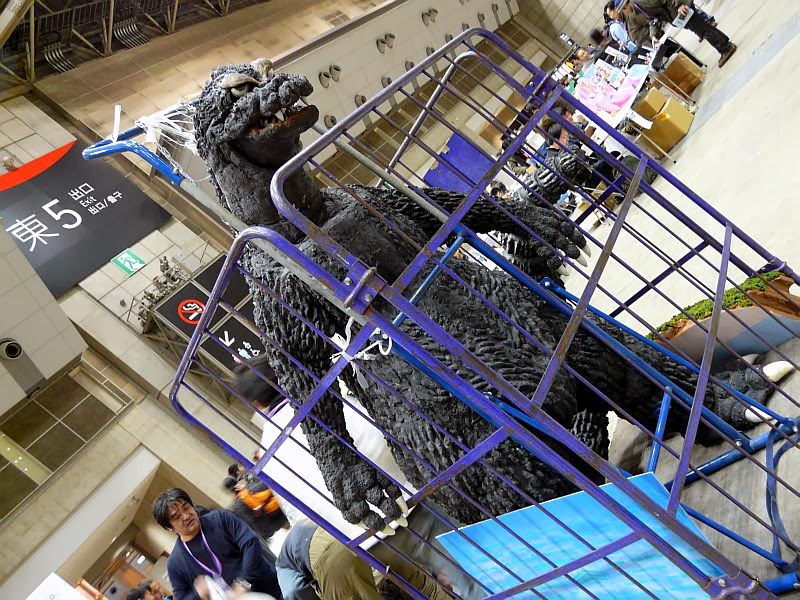
Giant Godzilla And King Ghidorah From Summer Wonder Festival


It seems that they or at least King Ghidorah may be for sale the sign in front of Ghidorah translates to about 19,500 American dollars.

Monday, January 27, 2014

Official Godzilla (Japanese) Website Updated


The official Japanese Godzilla website has been updated with new content. There is an interview section "Godzilla and I", a filmography (with some fantastic production stills), there is a toy and merchandise section, which includes a number of S.H. MonsterArts figures as well as some other merchandise but surprisingly no X-Plus. There will also be some sort of surprise on the site, hopefully something to do with the new film.


Sunday, January 12, 2014

Godzilla Returns: His Changing Cultural Significance

From The Japan Times
By Jun Hongo

It's been almost 60 years since the celluloid monster, awoken and empowered by radiation, first ravaged Tokyo. With a U.S. reboot scheduled to be released worldwide this summer, we examine the shifting views of the savage beast over time.

Despite being an expert on contemporary literature as well as 20th-century Russian literary criticism, Waseda University professor Toshio Takahashi also teaches a course on the symbolism of monsters, or — more specifically — the ways in which monsters are cognitive figures that reflect the real world.

“The course starts with a lecture that defines what monsters are,” Takahashi said.

“There are two principal elements,” he continued, explaining that monsters in early Western works of literature were first and foremost creatures created by humans that often revolted against their masters. Mary Shelley’s “Frankenstein” or H.G. Wells’ “The Island of Dr. Moreau” stand out as obvious examples of such themes at work.

In addition, Takahashi said, tales that were set around a monster usually carry an implicit warning against humans and their actions. Monsters were typically misunderstood creatures that were persecuted and hunted down simply because they were different, the 61-year-old professor said.

Does Godzilla fit the profile of a monster? Most definitely, said Takahashi, who published a book titled “Godzilla no Nazo” (“The Mysteries of Godzilla”) in 1998.

Monster or not, the giant creature has certainly been keeping a low profile in Japan, with Toho Studios declaring in 2004 it would put its “Godzilla” series on hiatus after it released “Godzilla: Final Wars” to mark the 50th anniversary of the franchise.

However, that hasn’t stopped Hollywood from preparing to launch a reboot of the franchise this coming spring. Released ahead of the 60th anniversary of “Godzilla” later this year, the jury’s still out on whether fans of the original series will be satisfied.

“Godzilla is the quintessential symbol of human weakness,” Takahashi said, adding that he would have preferred to see a new installment of the Japanese “Godzilla” series released this year — especially since the timing seems appropriate.

“Godzilla” first appeared in cinemas across the country in November 1954 but its story line was heavily influenced by an incident eight months earlier at Bikini Atoll in the Marshall Islands.

On March 1, 1954, a fishing crew on the Daigo Fukuryu Maru (Lucky Dragon 5) was exposed to radiation following a hydrogen bomb test that was conducted by the U.S. Army in the Pacific. The boat’s chief radio operator, Aikichi Kuboyama, died upon return to Tokyo, and the events sparked a fierce anti-nuclear movement across the country, as citizens expressed concern about the unpredictable nature of nuclear weapons and contaminated fish in the food supply.

Over at Toho Studios, meanwhile, producer Tomoyuki Tanaka was in desperate need of an idea for a film after another project fell through at the last minute.

Upon reading about the nuclear incident in the Pacific and noting the box-office success of Warner Bros.’ 1953 film “The Beast from 20,000 Fathoms,” he came up with a story line that centered on a prehistoric monster that is awakened from a centuries-long sleep in the aftermath of a nuclear test.

The production team worked on the project from scratch, led by film director Ishiro Honda and special-effects mastermind Eiji Tsuburaya. Due to budget and time restrictions, the movie was filmed using a stuntman in a costume rampaging around a scale-model of Tokyo instead of the popular stop-motion animation method that had been used in the 1933 U.S. film “King Kong.” The stuntman who dressed in the Godzilla suit visited several zoos in order to get inspiration on how to move as a 50-meter-tall beast.

Many considered the project to be an oddball B-grade movie, but “Godzilla” was completed just eight months after the Bikini Atoll incident.

Movies were the favorite form of entertainment during the ’50s and ’60s in Japan, and “Godzilla” ruled over them all. More than 9.6 million people flocked to cinemas to see the film — box-office success that encouraged Toho to approve a sequel that was released six months later. The studio also exported the film to the United States, a move that eventually helped Godzilla to become closely associated with Japan’s pop culture.

The film’s initial success also came in spite of the fact it carried a strong, underlying anti-nuclear message. This was something Tanaka and his team had hoped to achieve from the outset — shoot an entertaining science-fiction movie that also included a message that warned of the consequences we face as we develop as a civilization.

In a book titled “Tokusatsu wo Meguru Hitobito” (“People who Create Special Effects”) that was published in 2011, Honda said one of the movie’s underlying themes focused on the clash between humanity and nature. Monsters are essentially representations of nature in a mutated form, he wrote.

“The story of the first ‘Godzilla’ movie was 90 percent tied to contemporary nuclear threats of the time, especially if you consider the film opened less than nine years after the bombs were dropped on Hiroshima and Nagasaki,” Waseda University’s Takahashi said.

A number of critics have even suggested that Godzilla’s looks and reptilian skin were a reference to the keloid scars suffered by hibakusha after the atomic bomb attacks on Hiroshima and Nagasaki, although the creators have expressly denied any deliberate link.

And yet Honda has been quoted as saying he filmed Godzilla’s rampage in such a way so that he could draw parallels between the monster’s onslaught and the devastation caused by a nuclear bomb attack.

“Godzilla was created as a nuclear monster,” Takahashi said.

The more “Godzilla” sequels Toho produced, however, the further the franchise moved away from its initial anti-nuclear stance. Instead, the creature found itself being increasingly called on to face other ferocious beasts, including King Kong, Mothra, Biollante, Mechagodzilla and SpaceGodzilla.

By the time the film’s domestic franchise released “Godzilla: Final Wars” in 2004, approximately 100 million people in Japan had seen at least one of the 28 films in the series in a movie theater.

Naturally, it didn’t take long for Toho to branch out into merchandising in order to cash in on Godzilla’s popularity, churning out an ever-evolving line of toys, games, comics and character goods. The evolution of Godzilla both as a film and a character can be traced through such items.

The screenplay of the original “Godzilla” in 1954 “was serious and gloomy, reflecting the anxieties of postwar Japan,” Chikafumi Hodo wrote in The Japan Times in 1992. “(Later) ‘Godzilla’ films became more and more recreational as Japan’s economy grew rapidly.”

The gargantuan creature had ceased being a symbol of nuclear devastation, Takahashi said.

“(Instead), it became an entertainment,” he explained. “No one was asking what Godzilla was any more. No one questioned why it came to exist in the first place.”

As a small child, Takahashi remembers the thrill of watching Godzilla destroy Japan’s cities on the TV screen. Like others in the theater, he inherently enjoyed watching buildings and cities being destroyed. However, he also remembers catching a glimpse of isolation in Godzilla’s eyes as the beast emerged slowly from Tokyo Bay.

“The first few movies of the series were based around a core theme. They questioned the very meaning of Godzilla and asked viewers to think about the meaning behind its inception,” Takahashi said. “Eventually, however, the series focused solely on kaijū (monsters) battling against one another. It was never the same again.”

Godzilla continues to survive in Hollywood remakes for the time being, but such movies typically depict the creature as a dangerous monster that needs to be defeated.

Domestic fans, however, see it differently. Somewhere deep inside, Takahashi said, the Japanese public is generally able to find room to forgive Godzilla for the devastation — however catastrophic it may be. They perhaps see a bit of themselves in the monster, including its association with the nuclear incidents, he explained.

In a book titled “Sayonara Godzilla-tachi” (“Goodbye Godzillas”), Waseda University professor Norihiro Kato took the argument one step further, arguing that the king of the monsters may in fact symbolize the spirits of Japan’s war dead revisiting the country. Hence the initial gloomy tone of the movie was “cleansed, pasteurized and detoxified” as the series — and Japan — evolved from its postwar era to the heyday of its economic prowess, Kato wrote.

However, no sooner than the monster’s transformation from a ruthless destroyer into a cute mascot was complete, Japan found itself facing a new nuclear crisis.

The sight of the crippled nuclear power plant on the coast of Fukushima creates a situation that is eerily similar to the events in the Pacific that spawned the original “Godzilla” movie in 1954.

Takahashi said the ongoing nuclear crisis has essentially killed off any likelihood that a new “Godzilla” movie can be produced and released in Japan for the foreseeable future.

“However, if someone was able to produce a new “Godzilla” movie in Japan under the existing circumstances, it would surely be epoch-making,” Takahashi said. “Such a movie would finally revisit the origins of the monster and take an introspective look at its state of being. What’s more, it would raise some very difficult but important questions to the audience about the state of Japan today.”

Thursday, December 19, 2013

Godzilla Website Updated For 60th Anniversary


The official TOHO Godzilla website has been update for his 60th anniversary with animation and sound, you can make him walk, roar, destroy buildings, and shoot his atomic breath with the right arrow key and "G" key. You can also make Mothra, "M" key, and King Ghidorah, "K" key, appear with sound. I tried other keys but none of the others don't appear to do anything yet. Check it out here.

Sunday, December 8, 2013

Kaiju Battle Gift Guide

A few suggestions for the kaiju fans out there and check out our Amazon store for more.


IDW Godzilla Trade Paperbacks
There a number Godzilla series collected in trade paperback format including Godzilla, Godzilla: The Half-Century War, Godzilla: Gangsters & Goliaths, Godzilla: Kingdom of Monsters, Godzilla: Legends, and they range in price from $17.99 to $19.99.


S. H. MonsterArts Figures
S. H. MonsterArts the line of Godzilla toys made by Tamashii Nations, the Collector's division of Bandai. Some of the figure feature effect packs, accessories, and all of them feature an impressive range of articulation. They include monsters from numerous Godzilla films as well as King Kong from the 2005 film. They're priced from $50 up to about $200.


X-Plus Figures
The X-Plus figure is a line of highly detail large scale vinyl figures including monsters from many Godzilla, Gamera, and other Kaiju films. They come in different scales 30cm, 25cm, etc. They range in price averaging around $200.


Godzilla T-Shirts
There are many Godzilla t-shirts available because of the upcoming movie in 2014 many are classic styles with a few graphical types as well. Most shirts range $15 and up.


Pacific Rim Merchandise
There is a bunch of merchandise based on the movie Pacific Rim including action figures, books, apparel, DVD, statues, etc. including both Kaiju and Jaegers from the film.
Related Posts Plugin for WordPress, Blogger...